
Is the Spray Foam in Your Loft Putting Your House Sale at Risk?
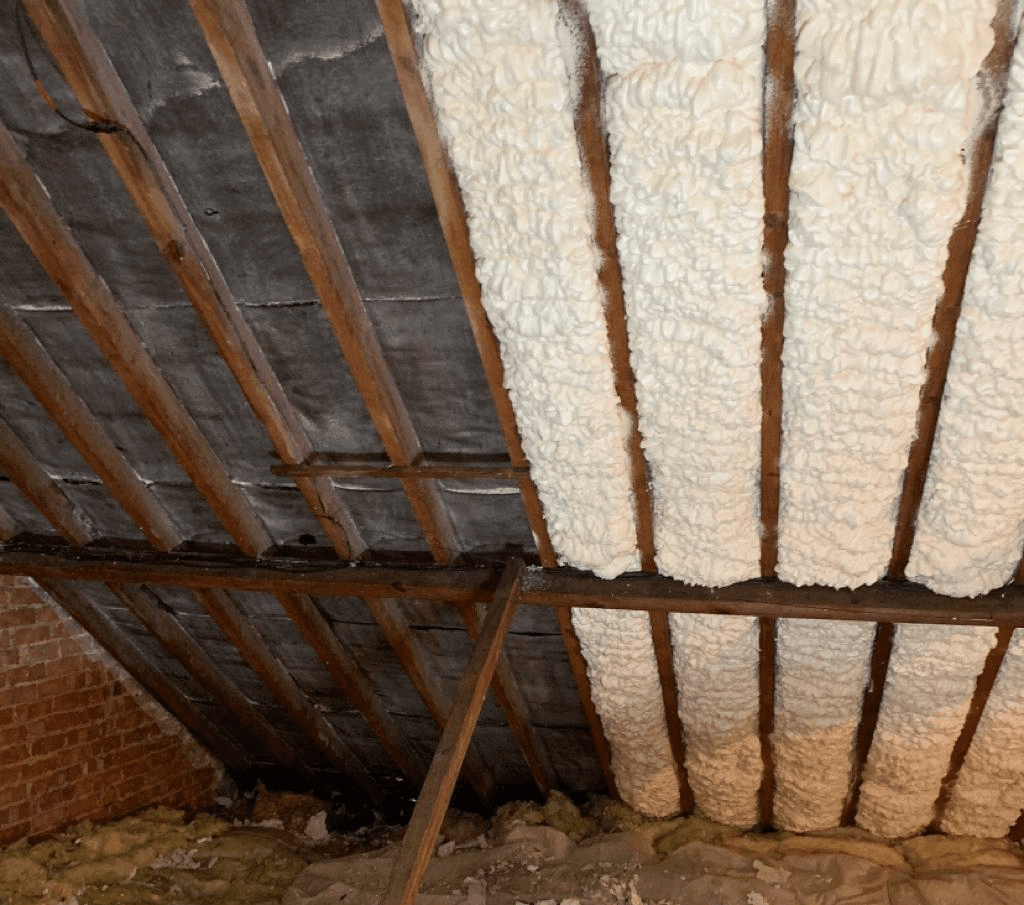
If you have spray foam insulation in your loft and you’re thinking of selling — or you’re already in the process — this is something you need to read before your sale falls through at the survey stage.
Spray foam insulation was widely promoted as an energy efficiency solution through the 2000s and 2010s. Some homeowners had it installed through government-backed schemes. Others paid for it privately. The problem is that what seemed like a sensible home improvement has become one of the most common reasons for property sales collapsing in 2026
What Are Surveyors and Lenders Actually Saying?
Under RICS guidance updated in 2025, surveyors are required to flag any loft insulation that prevents them from fully assessing the structural condition of roof timbers. Spray foam — particularly open cell foam — bonds tightly to rafters and joists. Once it’s in place, a surveyor cannot see, inspect, or probe the timber underneath.
This creates a fundamental problem for mortgage lenders. They cannot approve a loan secured against a property where the surveyor cannot confirm the structural integrity of the roof. The result: an estimated 71% of major UK mortgage lenders — including Halifax, Nationwide, Barclays, Santander, and TSB — will either decline to lend or significantly reduce their valuation on properties with spray foam insulation.
RICS 2025 update: Surveyors must now report spray foam insulation as a material fact that prevents full structural assessment. Properties are increasingly being valued at a reduced figure — sometimes £0 lendable value — until foam is removed and the structure can be reassessed. |
How Does This Affect Your Sale?
The most common scenario plays out like this: you accept an offer, your buyer’s solicitor instructs a surveyor, the surveyor flags the spray foam, the buyer’s mortgage lender either declines or reduces their offer, and the sale falls through or has to be renegotiated at a lower price.
In some cases sellers are only finding out about the problem weeks into a transaction — after they’ve already started their onward purchase. The financial and emotional cost at that point is significant.
Do You Know If You Have Spray Foam?
It’s not always obvious. Spray foam can look like grey or off-white rigid foam between rafters (closed cell) or a fluffy, soft beige/yellow foam (open cell). If you bought the property in the last 15 years and the previous owners made any energy improvements, it’s worth checking the loft before you go to market rather than finding out mid-sale.
What Are Your Options?
• Get a pre-sale assessment — EcoTrust offer free surveys with a written report on the type of foam, its condition, and the likely impact on your sale
• Get it removed before listing — removes the risk entirely, maximises your buyer pool, and can actually increase sale price by removing the uncertainty
• Price it in — some sellers choose to disclose and price accordingly, though this limits your buyer pool to cash buyers only
• Don’t ignore it — failing to disclose a known material defect creates legal risk
The most straightforward approach is removal before listing. It removes uncertainty for buyers and their lenders, opens up the full buyer market, and means there are no last-minute surprises mid-transaction.
How Long Does Removal Take?
For a standard 3-4 bedroom semi-detached, spray foam removal typically takes one to two days. EcoTrust will complete a free survey first, give you a fixed-price quote, and provide a completion certificate formatted to meet lender requirements. The whole process from initial survey to completion certificate is typically 2-3 weeks.
If your sale is already in progress and you’ve received a flag from the surveyor, call EcoTrust on 0800 870 8086. We understand the urgency of live transactions and prioritise where a sale is at risk.